
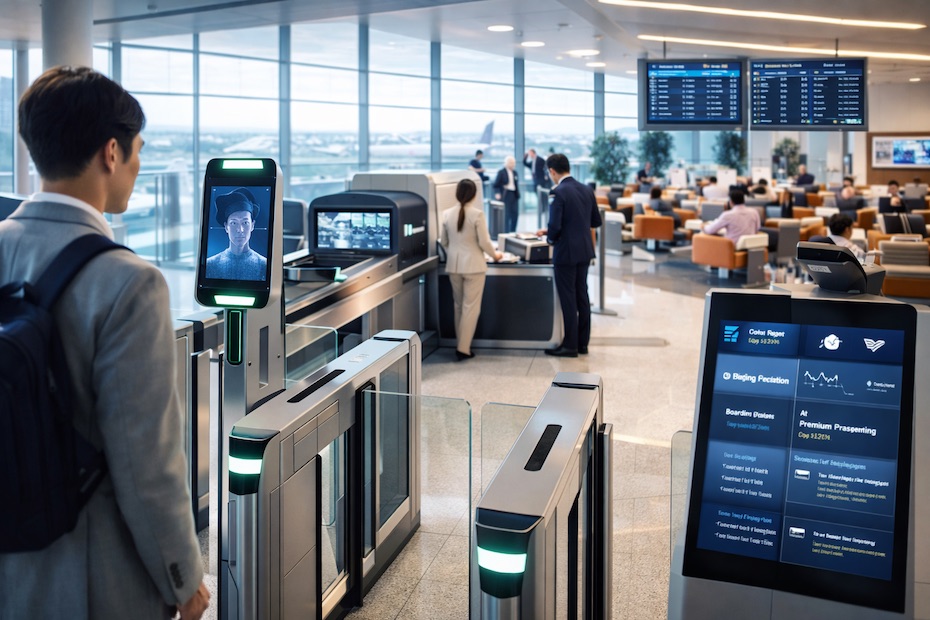
Luxury airports now rely on advanced airport technology to deliver faster processing, personalized service, and discreet efficiency for premium travelers. When implemented correctly, these systems remove friction from arrival to departure while maintaining high operational control.
This article breaks down the six airport tech solutions shaping seamless luxury travel in 2026, explains how each system works in real environments, and shows what decision-makers and frequent elite travelers should expect next.
1. Biometric Identity Systems: How Are Airports Eliminating Physical Checkpoints?
Biometric identity systems allow travelers to move through airports using facial recognition or digital credentials instead of physical documents. These systems link identity verification to boarding passes and airline records, reducing repeated checks.
Airports such as Singapore Changi, Dubai International, and several major U.S. hubs now operate biometric lanes for premium passengers. Travelers complete enrollment once, then move through check-in, security, and boarding with minimal human intervention. This cuts processing time while preserving accuracy.
From an operational view, biometrics reduce staffing pressure and lower manual error rates. Airlines gain tighter identity control, while travelers experience faster movement without repeated document handling. For luxury passengers, the value lies in discretion, speed, and continuity.
2. AI-Driven Security Screening: What Makes It Faster Without Reducing Safety?
AI-powered security screening uses machine learning to analyze carry-on items and passenger flow in real time. These systems flag anomalies automatically and allow security officers to focus on true risks instead of routine scans.
Several international airports have deployed CT scanners paired with AI software that removes the need to unpack electronics or liquids. Premium security lanes benefit most because throughput remains high even during peak hours.
The result is measurable time savings. Passengers clear checkpoints faster, while airports maintain strict screening standards. For luxury travelers, the benefit is predictable transit time through security without unnecessary interruption.
3. Smart Airport Lounges: How Is Personalization Delivered at Scale?
Smart lounges integrate traveler profiles, flight data, and real-time occupancy analytics to adjust services dynamically. Entry, seating, catering, and staff allocation respond automatically to passenger volume and preferences.
Many premium lounges now use digital access credentials, app-based service requests, and AI-assisted staffing tools. Travelers receive quieter spaces, faster service, and targeted amenities based on status or itinerary.
Operationally, lounges become more efficient without sacrificing experience. For travelers, the space feels controlled and intentional rather than crowded or reactive.
4. RFID Baggage Tracking: Why Are Lost Bags Becoming Rare for Premium Travelers?
RFID baggage tracking assigns each bag a digital identity that updates location data at every handling point. Airlines and airports receive continuous visibility across loading, transfer, and arrival.
Major airports report significantly lower mishandling rates where RFID systems operate at scale. Premium travelers receive mobile alerts confirming bag status before landing, reducing uncertainty and ground delays.
From a systems view, RFID improves accountability across handlers. For luxury passengers, it delivers confidence that luggage moves as reliably as the aircraft itself.
5. Autonomous Ground Mobility: How Are Airports Reducing Transfer Delays?
Autonomous ground vehicles now support baggage transport, aircraft servicing, and limited passenger movement within controlled zones. These systems operate with high precision and predictable routing.
Airports in Asia, the Middle East, and North America are expanding autonomous vehicle pilots for airside logistics. Reduced congestion and faster turnarounds benefit premium schedules.
For travelers, this translates into smoother gate transitions and fewer delays tied to ground operations. Reliability becomes part of the luxury experience.
6. Unified Digital Travel Platforms: How Do Airports Coordinate the Entire Journey?
Unified digital platforms connect airline systems, airport operations, passenger apps, and service providers in real time. Data flows continuously across check-in, security, boarding, and arrival.
These platforms allow airports to anticipate congestion, adjust staffing, and notify travelers instantly. Premium passengers benefit through tailored alerts, faster rerouting, and real-time service coordination.
At scale, unified systems reduce delays and manual intervention. For luxury travelers, the journey feels controlled rather than reactive.
Why Luxury Travelers Prioritize Airport Technology Over Aircraft Features
Elite travelers increasingly judge travel quality based on airport efficiency rather than aircraft interiors alone. Time saved on the ground often outweighs in-flight amenities.
Modern airport technology removes waiting, uncertainty, and noise from the experience. Predictable movement, privacy, and control define luxury more than physical space.
Airports that invest in technology retain premium travelers and airline partnerships. Those that lag risk losing relevance regardless of terminal aesthetics.
What Technology Improves Luxury Airport Travel the Most?
- Biometric identity processing
- AI security screening
- Smart lounges
- RFID baggage tracking
- Unified digital platforms
Where Luxury Travel Is Headed Next
Luxury airport travel now centers on precision, speed, and invisibility. Technology replaces friction without drawing attention to itself, allowing travelers to move smoothly while systems operate quietly in the background. Airports that adopt biometric identity, AI screening, and real-time coordination position themselves for long-term relevance. The future belongs to terminals that feel calm even under pressure. When airport systems perform correctly, luxury travelers notice one thing above all else—nothing slowing them down.

Robert Wilkos is the co-founder of VIPJets.com and a private aviation executive leading luxury charter services through a global network of 10,000+ aircraft. He champions rigorous Wyvern/ARGUS safety standards, 24/7 concierge support, and flexible options like the 25-Hour Jet Card, along with ground and air-medical transport.