
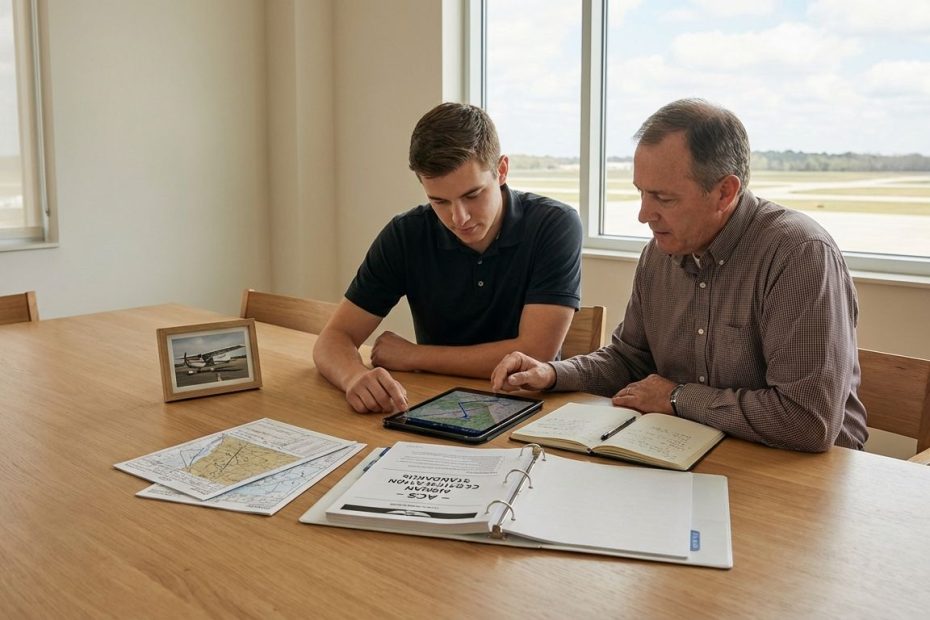
You survive student pilot training by turning vague stress into clear standards: train consistently, use the FAA’s ACS as your “test blueprint,” control the admin details early, and run every flight with a simple plan you can repeat under pressure.
This guide targets the problems that actually derail training: stretched timelines, skill plateaus, checkride nerves, paperwork delays, and rising costs. You’ll get practical tactics you can apply on the next lesson, plus a tight way to study for the oral and fly the maneuvers without “freezing.”
How Long Does It Really Take To Get A Private Pilot License (And Why Does Everyone Go Over 40 Hours)?
The FAA minimum for a Private Pilot certificate in single-engine airplanes is 40 total flight hours, but many students exceed that number due to weather cancellations, schedule gaps, and uneven lesson quality. The fastest path is not rushing, it’s training frequency, clean lesson goals, and fewer “relearn” flights caused by long breaks.
Start by anchoring expectations to what the rule actually demands. The minimum includes specific items that are non-negotiable: dual instruction totals, solo totals, night training, instrument training, and a final prep window close to the practical test date. When a student “goes over 40,” it’s rarely because of one big problem; it’s usually ten small inefficiencies that stack up across months.
Calendar time matters as much as logbook time. If training happens once every 10–14 days, skill decay drives you into repeat lessons and shortens the amount of time you can hold onto progress. A steady rhythm of 2–3 touchpoints per week (flight, sim, or structured ground) keeps landings, procedures, and radio work from sliding backward between lessons.
Set a measurable cadence and protect it. Use a fixed weekly schedule that survives work trips and family obligations, then use short ground sessions to “bridge” gaps when weather cancels. That one habit reduces total hours more reliably than any trick maneuver or extra study app.
I’m Falling Behind In Training, What Should You Do When Progress Stalls Or Landings Suddenly Get Worse?
When progress stalls, the fix is almost always precision: narrow the lesson target, define what “good” looks like, and repeat the same setup until the result stabilizes. A stall in progress usually comes from training that is busy but not targeted, mixed goals per flight, or changing technique week to week.
Landings are the classic “it was good last week, now it’s terrible” problem. That swing often tracks fatigue, winds, runway slope, pattern congestion, or inconsistent approach gates. If the approach is not stable, the flare becomes guesswork, and the landing feels random. Stabilize the input earlier and the output cleans up fast.
Run a reset flight that removes clutter. Brief one landing profile, then fly multiple patterns where the only scorecard is: correct airspeed trend, correct glidepath control, centerline discipline, and a consistent aim point. Talk through the corrections out loud, then debrief on the ground using short notes that capture what changed, not what felt bad.
If training stays stuck for more than a couple of weeks, schedule a stage check or a flight with another instructor. A second set of eyes often spots one root cause quickly: sight picture, rudder timing, trim usage, or late power changes. The goal is not validation, it is a faster diagnosis so money and time stop bleeding out of the schedule.
How Do You Deal With Checkride Anxiety Without Letting It Wreck The Oral Or Maneuvers?
Checkride anxiety gets managed through process. You slow the pace, verbalize what you’re doing, and give the examiner a steady stream of safe decision-making. The applicant who stays organized usually outperforms the applicant who tries to be perfect.
On the oral, use a clean structure for answers so the nerves do not scramble the delivery. Pause, then answer in a repeatable pattern: rule (what standard applies), risk (what can go wrong), action (what will be done in the airplane). That matches how the ACS is built, so the examiner hears the response in the same categories used to grade the task.
On the flight, anxiety spikes when the airplane is “ahead” of the pilot. Fix that by slowing down the workflow, not by muscling the controls. Before each maneuver: clear the area, set altitude, set speed, set configuration, then start. If the setup is rushed, the maneuver starts sloppy, and every correction afterward feels like damage control.
Speak during the flight portion. Call out deviations early and correct them early, since a timely correction is far better than silent overcontrol. Training community advice repeats the same theme: do not introduce new techniques at the last minute, and do not rush maneuvers just to “get through the list.” A steady pace prevents avoidable errors more than any last-night cram session.
What Are The Most Common “Gotchas” That Delay Solo And Checkride Readiness (Medical, IACRA, Endorsements, Logbook)?
The most expensive delays are administrative. Medical scheduling, student pilot certificate timing, missing knowledge test paperwork, incorrect IACRA entries, and incomplete endorsements can shut down a solo or postpone a checkride even when the flying is ready.
Put admin into a single “training operations” checklist that gets updated weekly. Keep a folder with: government ID match, medical, student pilot certificate status, knowledge test report, IACRA application status, written test expiration awareness, and all required endorsements. This reduces the last-minute scramble that tends to happen right when the flying schedule gets busy.
One regulation detail causes frequent surprise: checkride prep time has a timing requirement. The rule for private pilot airplane requires 3 hours of flight training in preparation for the practical test within the preceding 2 calendar months from the month of the test. If the checkride date slides, the training may need to be re-accomplished to stay compliant, which can add cost and calendar time.
Operationally, treat the checkride like a project with dependencies. If the DPE date is tentative, keep the final prep flights close enough to satisfy the rule while still leaving room for weather. If the local DPE backlog is long, start building the paperwork packet earlier than feels necessary, since admin delays tend to surface late and block the finish line.
How Much Does Student Pilot Training Cost In 2025–2026, And What Actually Drives The Total?
Cost is driven by three levers: aircraft hourly rate, instructor hourly rate, and total hours to proficiency. The part you control most is the third lever, since training gaps and repeated lessons inflate hours quickly.
Rates vary by region, but published school pricing gives a useful reference point for planning. One large U.S. flight training provider lists (effective 11/1/2025) a Cessna 152 at $163/hr, Cessna 172P/172SP at $211/hr, simulator time at $98/hr, and flight/ground instruction at $88/hr, with DPE practical exam fees commonly noted as $700–$1000+. Those numbers are not universal, yet they reflect the current market reality many students face.
Most budget blowouts come from avoidable inefficiency. Long gaps between flights create relearning hours, checkride postponements create “keep warm” flights, and lack of a structured syllabus creates random practice that feels productive but does not move proficiency. Add a couple of weather weeks, and the budget drifts without anyone making a conscious decision.
Control cost without cutting corners by tightening the training loop. Schedule in blocks, debrief immediately, chair-fly procedures at home, and use simulator time for flows and instrument scan when that supports the lesson objective. Treat every paid hour as a measurable training event with a target and a debrief note, not just “more time in the airplane.”
What Should You Study First For The Oral Exam, And Which FAA Documents Matter Most?
Start with the Private Pilot Airplane ACS and build study around its tasks. The ACS is the grading sheet, so studying without it often leads to wasted time on trivia and weak performance on high-frequency topics like airspace, weather decision-making, performance, and systems.
The FAA ACS list shows the current Private Pilot Airplane ACS (FAA-S-ACS-6C) with a publication date of April 2024 and effective May 31, 2024. Use that to organize both knowledge and flight standards, since the ACS ties together what must be known, what risks must be managed, and what must be demonstrated.
Build a three-layer study stack. Layer one is the ACS task list, used as a checklist and progress tracker. Layer two is your core references: Pilot’s Handbook of Aeronautical Knowledge, Airplane Flying Handbook, and the FAR/AIM sections tied to your weak tasks. Layer three is local and aircraft-specific: POH limitations, performance planning, equipment requirements, local airspace traps, and common ATC flows at the home airport.
Keep oral prep practical and short-cycle. Convert each ACS task into a one-page brief: definitions, applicable rules, the risk, and the cockpit action. Then practice speaking the answers out loud, since checkride performance depends on clarity and organization as much as raw knowledge.
What Tools Actually Help Student Pilots Manage Workload Without Becoming Dependent?
Tools help when they build consistency and reduce errors, and they hurt when they replace basic competence. The correct goal is supported performance: use an EFB and checklists to reduce workload, then maintain a simple “no-EFB fallback” that keeps navigation, airspace awareness, and planning functional.
Electronic flight bags can be worth the cost when used intentionally. ForeFlight’s individual pricing lists Starter billed annually at $130 and Essential billed annually at $260, with higher tiers adding features that matter more as IFR and cross-country complexity increases. Pick a plan that matches your training phase, then learn it well enough that it speeds you up rather than distracting you.
Workload management starts before engine start. Build a standardized cockpit flow: preflight setup, nav setup, comm plan, and a brief you can repeat. A stable routine reduces missed checklist items, prevents radio surprises, and keeps pattern work from turning into improvisation under pressure.
Maintain tool discipline with a weekly “degraded mode” drill. Write down frequencies, headings, and the basic route before taxi, then fly a short local leg relying on the same fundamentals used without moving-map guidance. This maintains confidence, sharpens scan discipline, and keeps checkride day from being the first time technology hiccups feel like an emergency.
How Do You Build A Checkride-Ready Week When The Practical Test Is Close?
With the checkride close, training needs to become tighter, not bigger. The correct focus is repeatable performance under normal workloads: consistent setups, consistent callouts, and clean decision-making when things drift.
Start by cleaning up the “packet.” Logbook totals and required aeronautical experience should be tabbed and easy to verify. Endorsements should be legible and complete. IACRA status should be checked early enough that corrections do not become a day-before fire drill.
Then tighten flying into short, scoring-focused sessions. Run the maneuvers in the same order used in typical checkrides at the local area, including clearing procedures and a disciplined setup. The goal is to stop discovering surprises on checkride day, since surprises are what spike workload and drive errors.
Keep study narrow and verbal. Build a short oral script for high-yield topics: weather interpretation, risk decisions, systems failures, airspace, performance planning, and required documents. Then rehearse answers out loud, since a clean explanation under mild stress is the real test, not silent reading.
How Do You Reduce Checkride Anxiety Fast?
- Slow down, brief each maneuver, then set speed/altitude before starting.
- Answer in order: rule, risk, action.
- Fix deviations early, talk through corrections, keep flying the plan.
Fly The Plan You Can Repeat
Student pilot training rewards consistency more than intensity. Hold a stable weekly schedule, keep each lesson focused on one measurable skill, and use the ACS as the map for both studying and flying. Lock down paperwork early so admin issues do not steal momentum right when proficiency arrives. Manage costs by reducing wasted hours, not by cutting safety margins. When checkride day arrives, win by pacing, organization, and clean setups, then let the skills built through repetition do the work.

Robert Wilkos is the co-founder of VIPJets.com and a private aviation executive leading luxury charter services through a global network of 10,000+ aircraft. He champions rigorous Wyvern/ARGUS safety standards, 24/7 concierge support, and flexible options like the 25-Hour Jet Card, along with ground and air-medical transport.