
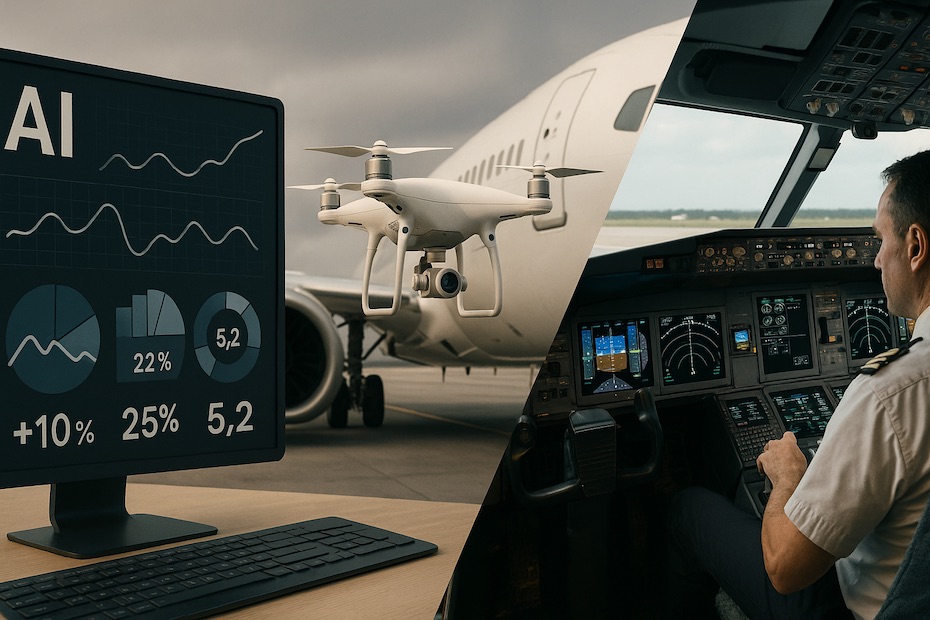
You transform aviation operations significantly by adopting AI tools that improve efficiency, safety, and cost savings across maintenance, routing, ground services, inspections, and cockpit support.
This article highlights five AI solutions reshaping aviation right now. You’ll learn what each tool does, why it matters, and how you can integrate it into daily operations to achieve measurable improvements.
Tool 1: Predictive Maintenance AI
Predictive maintenance AI uses data from sensors installed in engines, avionics, and mechanical systems to anticipate failures before they happen. By continuously monitoring vibration, temperature, and performance metrics, these algorithms detect early warning signs.
This reduces unplanned maintenance and lowers the risk of grounding aircraft unexpectedly. Airlines like Delta and Lufthansa already deploy predictive systems to save millions in repair costs and avoid costly delays.
When you implement predictive maintenance, your engineers focus only where action is needed instead of wasting time on unnecessary checks, improving fleet readiness and resource allocation.
Tool 2: AI for Flight Path and Scheduling Optimization
AI-driven flight planning systems consider weather, fuel burn, and air traffic congestion to recommend optimal routes. Unlike traditional systems, these models adapt dynamically in real time.
American Airlines, for instance, uses AI to decide whether to delay certain outbound flights slightly so inbound connections aren’t missed—reducing disruption for passengers and improving efficiency.
Fuel is the largest operational cost in aviation, and smarter routing decisions supported by AI shave off thousands of gallons annually. By applying these tools, you can align cost control with sustainability goals.
Tool 3: Ground Operations AI
Ground handling involves gate assignments, baggage logistics, refueling, and turnaround coordination. AI excels at managing these high-volume, time-sensitive processes.
AI systems predict bottlenecks, optimize crew allocation, and assign gates that minimize taxi times. At large hubs, this means fewer delays and smoother passenger transfers.
Additionally, computer vision AI monitors apron activities for safety compliance—scanning zones for unauthorized vehicles or equipment in dangerous proximity. By integrating ground AI, you cut idle time and improve turnaround performance.
Tool 4: Autonomous Inspection Drones and Robotics
Aircraft inspections once required long manual checks by technicians on lifts and scaffolding. AI-powered drones and robots now perform much of this work autonomously.
Companies like Donecle deploy drones to scan aircraft exteriors in less than 30 minutes, identifying cracks, dents, or lightning strike marks with precision. Air-Cobot robots handle lower surface inspections using advanced imaging sensors.
By adopting autonomous inspection tools, you reduce downtime drastically. What previously took several hours with human teams can now be completed in a fraction of the time, while producing more consistent and reliable inspection reports.
Tool 5: AI Assistants and Copilots in the Cockpit
AI copilots powered by advanced natural language models support pilots during flight. These tools monitor cockpit data, analyze procedures, and suggest the next step when issues arise.
Early studies show AI copilots can achieve high accuracy in referencing operational manuals and detecting potential conflicts in taxi instructions. By reducing pilot workload, these tools increase safety margins and improve decision-making in complex environments.
You can expect AI copilots to expand further, eventually becoming a trusted second set of “digital eyes” in every flight deck.
Why are airlines investing heavily in these AI tools?
You see airlines investing because the ROI is undeniable. Predictive maintenance saves millions, AI scheduling reduces fuel burn, and inspection drones eliminate hours of downtime.
In addition to efficiency, safety improves when AI consistently monitors thousands of data points beyond human capacity. Airlines that adopt early gain both operational advantage and customer trust.
Common benefits include:
- Lower fuel costs from optimized routes
- Fewer AOG events and reduced downtime
- More consistent inspection quality
- Safer ground handling and reduced accidents
- Enhanced pilot support and decision-making
What challenges should you expect when adopting AI in aviation?
The first challenge is certification. Aviation is heavily regulated, and every AI system must pass strict validation before integration into critical workflows.
Data quality is another hurdle. Poor sensor calibration or inconsistent logging reduces the accuracy of predictive tools. You need high-integrity datasets for AI to be effective.
Finally, trust is a key barrier. Pilots, engineers, and regulators must believe in the system. This requires transparent AI models that explain their decisions and clear fallback procedures.
How can you implement AI tools step by step?
You should start small. Deploy predictive maintenance pilots on a limited fleet, measure results, and scale gradually. Once validated, expand to routing optimization and ground handling.
Integrating across systems delivers the biggest value. Imagine predictive maintenance working alongside inspection drones—data flows seamlessly between them, giving engineers actionable insights instantly.
Engage regulators early. Certification processes take time, but proactive engagement ensures smoother adoption. Build operator training into your rollout to encourage adoption and reduce resistance.
What are the top AI tools transforming aviation operations?
- Predictive maintenance systems
- AI-driven routing and scheduling
- Ground operations optimization
- Autonomous inspection drones and robots
- AI copilots in the cockpit
In Conclusion
AI is already transforming aviation, and adoption is accelerating. Predictive maintenance, smart routing, ground AI, inspection drones, and AI copilots deliver measurable results in cost savings, safety, and efficiency. By taking a structured adoption path, you’ll position your operations ahead of competitors and prepare for an AI-driven aviation future.
If you’re ready to explore how AI tools can elevate your aviation operations, connect with me at my website.com to start shaping your strategy today.

Robert Wilkos is the co-founder of VIPJets.com and a private aviation executive leading luxury charter services through a global network of 10,000+ aircraft. He champions rigorous Wyvern/ARGUS safety standards, 24/7 concierge support, and flexible options like the 25-Hour Jet Card, along with ground and air-medical transport.